Does your skin feel tight after a shower? Are you looking for a gentle cleansing solution? The term “superfatted liquid soap” comes up a lot, but what does it really mean? Discover how a genuine handcrafted soap, rich in natural glycerine, can transform your hygiene routine and give your skin the protective care it deserves.
What is surgras liquid soap and why is it essential?
In everyday language, surgras liquid soap refers to a washing formula enriched with nourishing agents to prevent skin dryness. Technically, this means that some of the vegetable oils used in its manufacture have not been transformed into soap, creating a “surgras” that remains on the skin to protect it.
This approach aims to preserve the hydrolipidic film, the epidermis’ natural protective barrier that maintains hydration and defends us against external aggression. A conventional soap or industrial shower gel can alter this film, causing tightness and irritation. A gentle cleanser, whether superfatted or naturally rich in glycerine, cleanses effectively while leaving a protective film.(Saponification)
- Definition of “surgras”: an excess of non-saponified vegetable oils, designed to nourish the skin.
- Role of the hydrolipidic film: an essential barrier against dehydration and bacteria.
- Key difference: an enriched soap respects the skin’s balance, unlike a detergent which can strip it.
- The liquid format: offers optimum comfort and hygiene for daily use by the whole family.
The mechanism of a mild soap on the epidermis
The aim of a high-quality soap is to cleanse without depriving the skin of its essential lipids. In a superfatted soap, excess oils compensate for lipid loss. But an equally effective approach is to rely on natural glycerine. This powerful humectant, produced during saponification, attracts and retains water in the upper layers of the epidermis. A soap that retains its native glycerine offers immediate soothing action on dry areas (hands, elbows, legs) and guarantees long-lasting hydration.
Who needs a moisturizing cleanser?
While everyone benefits from gentle cleansing, some skin types need it more than others. A moisturizing liquid soap is particularly recommended for :
- Atopic, dry and sensitive skin: it acts as a protective shield to calm irritation and prevent itching.
- Frequent hand washing: preserves moisture and helps prevent cracking, even with rigorous hygiene.
- Hygiene for the whole family: its gentle formula is perfectly suited to the delicate skin of children as well as that of older people. For the little ones, a natural baby soap is the safest option.
The science behind manufacturing: Saponification and glycerine
Genuine liquid soap is more than just a mixture of foaming agents. It’s the fruit of an age-old, mastered chemical process: saponification. This reaction transforms fats (vegetable oils) into soap and glycerine using an alkaline agent (potash for liquid soaps).
The choice of oils is decisive for the final quality of the product. Oils such as sunflower, hemp, coconut and castor each contribute their own properties: softness, cleansing power and a creamy, natural lather. In an artisanal process, glycerine, an exceptional moisturizer, is carefully preserved, whereas it is often extracted from industrial soaps for resale (FDA regulations).
Native glycerin: the forgotten humectant
Glycerine is the hidden treasure of saponified soap. This natural by-product of the reaction is a humectant: it has the ability to attract moisture from the air and retain it in the skin. It’s what gives your skin that supple, comfortable feeling after a shower. A soap from which the glycerine has been removed is a stripping soap, because it cleanses without giving the skin the moisture it needs.
- Definition: Glycerin is a natural, moisturizing co-product of saponification.
- Power : Keeps skin supple and hydrated by capturing water.
- Conclusion: A soap without its native glycerine is incomplete and potentially drying.
The benefits of quality vegetable oils
Rather than simply adding oils at the end of the process, the quality of a soap depends above all on the oils chosen for saponification. Oils rich in essential fatty acids (such as omega-3 and 6) give soap regenerating and soothing properties. When you read the label, the presence of names such as “Potassium Sunflowerseedate” or “Potassium Cocoate” at the beginning of the list indicates that the product is indeed derived from the saponification of these oils and not from a synthetic washing base.
Saponified soap vs. industrial shower gels: The great comparison
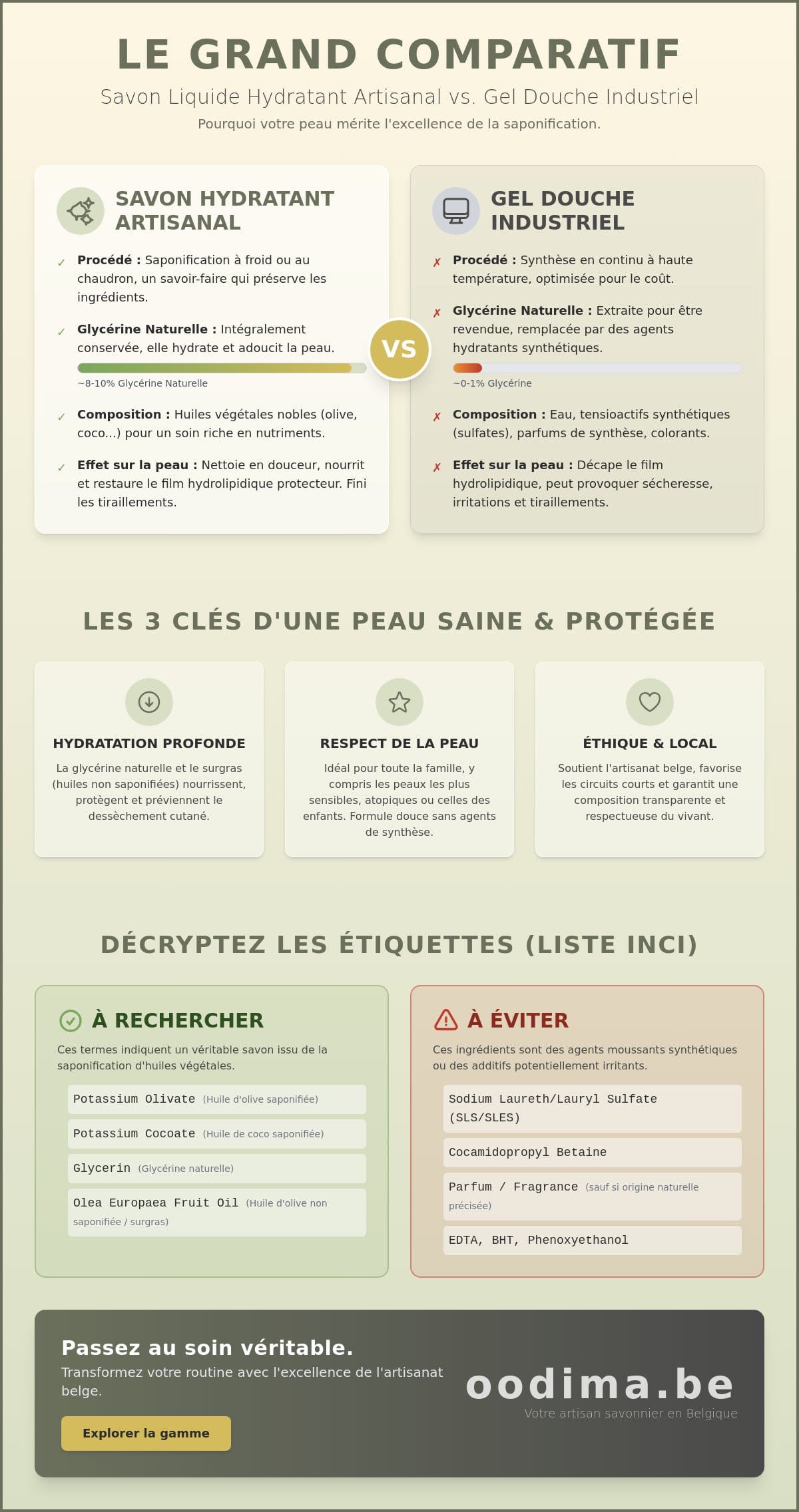
On paper, both products wash. In reality, their impact on your skin and the environment is radically different. The main point of friction lies in the washing agents, or surfactants.
A traditional soap uses saponified oils. Industrial shower gels, on the other hand, rely mainly on synthetic surfactants, often derived from petrochemicals, such as Sodium Laureth Sulfate (SLS). These agents create an abundant lather, but can be aggressive to the epidermis and not very biodegradable. Choosing a 100% natural liquid soap means opting for a simple, effective and respectful formula.
The danger of sulfated surfactants
Sulfates like SLS are effective at dissolving grease, but they don’t differentiate between impurities and your skin’s protective sebum. Their use can lead to :
- Irritation of fragile skin: they alter the hydrolipidic film and can cause redness and itching.
- A “rebound” effect: by stripping the skin, they cause it to produce even more sebum to defend itself, which can aggravate oily skin problems.
- A gentle alternative: saponified soap cleans by a different, much gentler and non-irritating mechanism.
Biodegradable and water-friendly
Natural soap is entirely biodegradable. Once in wastewater, it rapidly breaks down into simple elements without harming aquatic flora and fauna. Conversely, many synthetic compounds found in shower gels (preservatives, texturizing agents, fragrances) are bioaccumulative. Favoring locally-produced soap also reduces the carbon footprint associated with transport, and supports a more virtuous economy.
How to choose the right moisturizing liquid soap: Practical guide
Faced with a multitude of options, knowing how to read a label is your best bet. Don’t just rely on marketing claims like “gentle” or “moisturizing”, analyze the composition.
- Decipher the INCI list: the first ingredients are the most important. Look for the names of saponified oils.
- Look out for labels: serious organic certification guarantees the absence of pesticides and synthetic chemicals.
- Avoid synthetic fragrances: for reactive skin, opt for fragrance-free formulas or those scented only with essential oils.
- Think green: opt for reusable pump bottles and refills to limit waste.
Learn to read the INCI label
The INCI list (International Nomenclature of Cosmetic Ingredients) is your guide. Ingredients are listed in descending order of concentration. Here’s how to find your way around:
- The right ingredients: Aqua, Potassium Cocoate, Potassium Sunflowerseedate, Potassium Castorate, Potassium Hempseedate, Glycerin… These terms indicate a genuine liquid soap based on coconut, sunflower, castor and hemp oils. Glycerin should be prominent.
- Ingredients to avoid: Sodium Laureth Sulfate (SLS), Sodium Lauryl Sulfate (SLES), PEG, EDTA, Paraben, BHT… These are markers of industrial formulas.
The importance of natural fragrance
A synthetic fragrance (“Parfum” or “Fragrance” in the INCI) is a cocktail of potentially allergenic molecules. Essential oils, in addition to their delicate fragrance, can provide aromatherapeutic benefits (soothing lavender, purifying tea tree…). For extremely sensitive skin or babies, a totally fragrance-free formula is ideal.
The excellence of Oodima liquid soap: Natural and Belgian
At Oodima, we believe that soap should be a care product first and foremost. That’s why our liquid formulas are 100% natural, certified organic and the result of genuine artisanal saponification. We don’t use ready-to-use washing bases, but manufacture our soap from A to Z in our Liège workshop.
Our commitment to short supply chains is at the heart of our approach. We carefully select our raw materials, like our organic sunflower oil from “Equilibre” and our organic hemp oil from “Cannavie“, two Belgian producers who share our values. By choosing an organic soap producer in Belgium, you’re supporting a local economy and ethical production.
Transparent, committed manufacturing
Founded by Olivier and Dimitri, Oodima was born of a passion for authentic skincare and respect for the skin. We focus exclusively on what we do best: body soaps. You won’t find any household products or shampoos with us, because we dedicate all our know-how to body hygiene. Each bottle is the guarantee of a product manufactured and controlled in Belgium, in compliance with the strictest European standards.
Why switch to Oodima in 2026?
Choosing Oodima means opting for peace of mind. It means knowing that you’re applying a healthy product to your skin, formulated with pure, effective ingredients. It’s the assurance of a local, committed alternative to the parapharmacy giants. It means rediscovering the simple pleasure of soft, healthy, perfectly moisturized skin.
Discover our range of certified organic liquid soaps
Frequently asked questions (FAQ)
- What’s the difference between a classic liquid soap and a superfatted soap?
- A classic liquid soap can be a synthetic detergent. A “surgras” soap is a real soap enriched with non-saponified oils. The aim is the same: gentle cleansing. This effect can also be achieved with a handcrafted soap that retains all its natural glycerine, offering deep hydration without adding fat.
- Can moisturizing liquid soap be used on the face?
- Yes, a high-quality saponified liquid soap with no synthetic fragrances and a suitable pH is gentle enough for use on the face, especially for normal to dry skin. Always avoid contact with the eyes.
- Why does my natural liquid soap sometimes change color or texture?
- It’s a sign of its artisanal character! With no texturizing agents or synthetic stabilizers, a natural soap may vary slightly according to temperature or batches of vegetable oils. A slightly cloudy appearance or slight thickening in cold weather is normal and in no way detracts from its quality.
- Is a mild soap effective against bacteria and viruses?
- Absolutely. The washing action of soap, whether mild or not, destroys the lipid envelope of viruses (such as influenza or coronavirus) and eliminates bacteria. A 30-second handwash with natural soap is just as effective as an aggressive antibacterial product.
- Can moisturizing liquid soap be used to wash a baby?
- Yes, as long as you choose a very simple formula, with no essential oils or fragrances. As babies’ skin is extremely fine and permeable, a natural, organic soap with no additives is the best option for respecting its fragile balance.
- Does surgras liquid soap lather as much as shower gel?
- No, and that’s a good thing. An exuberant lather is often a sign of the presence of sulfated surfactants. A handcrafted soap produces a finer, creamier, smoother lather, which cleanses perfectly without aggressing the skin.
- How long does organic handmade liquid soap keep?
- Thanks to natural preservatives approved for organic cosmetics, artisanal liquid soaps generally keep for 6 to 12 months after opening. Refer to the PAO (Période Après Ouverture) symbol on the label.
- Is moisturizing soap suitable for oily or acne-prone skin?
- Yes, it’s often an excellent solution. Oily skin reacts badly to stripping and produces even more sebum to defend itself. Using a gentle cleanser purifies the skin without triggering this “rebound effect”, helping to regulate sebum production over the long term.