Did you know that the product that foams the most in the bath is often the worst enemy of your child’s skin? With the entry into force of the new European Omnibus VIII standards in May 2026, cosmetic safety has taken a crucial step forward. Choosing a natural baby soap is no longer simply a matter of aesthetic preference: it has become an essential shield against CMR substances and endocrine disruptors, which are now banned. Your priority is to protect this skin barrier, which is still so fine and reactive.
No doubt you share this frustration when faced with indecipherable labels or rashes that appear despite your precautions. This comprehensive guide gives you the keys to identifying truly safe formulations and understanding why cold saponification outperforms industrial methods. Together, we’ll explore the new labelling requirements for 81 fragrance allergens, to simplify your daily routine. You’ll learn how to choose local, ethical solutions, rooted in Belgian know-how, to transform bath time into a protective, transparent and serene experience.
Key points
- Understand the specifics of the newborn’s immature cutaneous barrier to better protect it from external aggression.
- Learn how to decipher labels to choose a natural baby soap rich in vegetable oils and guaranteed free of essential oils.
- Compare the benefits of solid soap for its zero-waste approach and natural liquid soap for its practicality when changing clothes or bathing.
- Adopt the right cleansing rituals, from water temperature to hand-soaping, to respect the delicate balance of the epidermis.
- Discover the advantages of cold saponification and local Belgian manufacturing for healthy, ethical and transparent hygiene.
Table of contents
Understanding baby’s skin: why the choice of soap is crucial
Deciphering the label: which ingredients make a safe baby soap?
Understanding baby’s skin: why the choice of soap is crucial
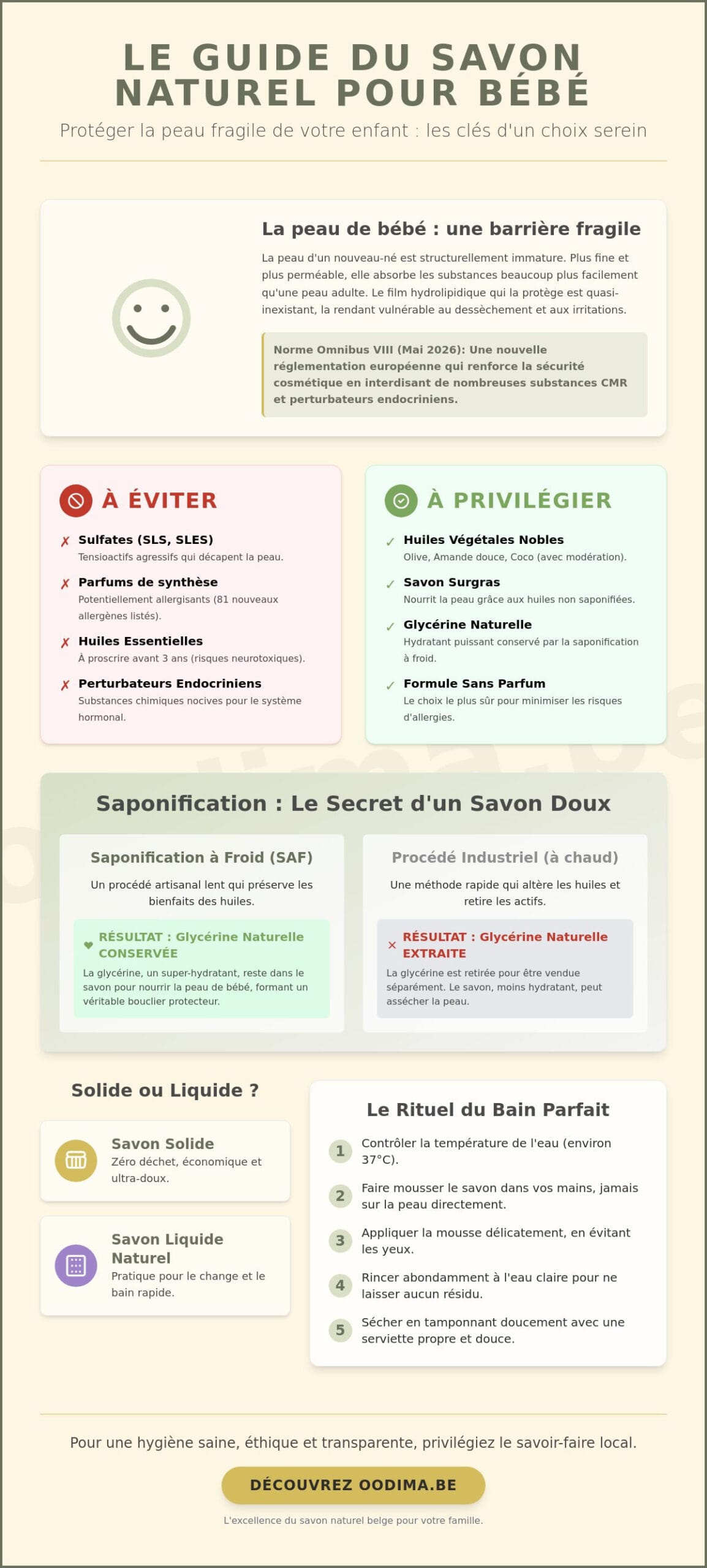
Infant skin is a fascinating yet extremely vulnerable organ. Unlike adult skin, newborn skin has a much thinner stratum corneum and less tight cell junctions. This structural immaturity makes the cutaneous barrier particularly permeable to external aggression. The hydrolipidic film, that precious mixture of sebum and sweat that protects the epidermis, is still virtually non-existent at birth. Without this protection, the skin rapidly dries out and becomes a gateway for irritants. The use of a natural baby soap therefore becomes a physiological necessity to support the development of this protective organ.
Industrial products frequently use synthetic surfactants, such as sulfates, to generate abundant foam. These washing agents are far too powerful for infants. They strip away the few lipids present on the surface, causing tightness, redness and sometimes dermatitis. Overly aggressive cleansing also disrupts the skin’s natural pH. This must remain slightly acidic to promote healthy skin flora and avoid enzymatic stripping, which weakens the deep layers of the epidermis.
Skin permeability: a risk of chemical absorption
The ratio of body surface area to body weight is much higher in infants than in adults. For the same amount of product applied, the dose that penetrates the body is proportionally much greater. This is where the quality of your natural baby soap comes into play. It’s not just a marketing ploy. It’s a guarantee of the absence of endocrine disruptors or toxic substances, in line with the new requirements of the Omnibus VIII regulation of May 2026. Synthetic fragrances, often loaded with allergens, considerably increase the risk of sensitization in atopic skin. Total transparency on ingredients is the only way to guarantee absolute safety.
Surgras soap: baby’s natural shield
To compensate for the weakness of the hydrolipidic film, you should choose a so-called “superfatted” soap. This term refers to a product in which some of the vegetable oils have not been converted into soap during the manufacturing process. These oils remain free and directly nourish the skin during washing. Unlike conventional shower gels, artisanal soap retains all its vegetable glycerin. This substance is an exceptional natural humectant that captures moisture from the air and locks it into the skin. Rather than simply providing temporary external hydration, ultra-rich soap strengthens the very structure of the skin barrier. It creates a true protective shield that prevents dehydration while cleansing with infinite gentleness.
This protective approach is also at the heart of the work of artisans like Glamorously Her, who offer handmade natural soaps to extend these benefits to the whole family.
Deciphering the label: which ingredients make a safe baby soap?
Reading an INCI list often seems like a linguistic challenge. Yet your child’s safety depends on this careful analysis. For a high-quality natural baby soap, vegetable oils should be at the top of the ingredient list. Oleic sunflower oil and olive oil remain the absolute reference for their exceptional richness in oleic acid. Sweet almond adds a soothing creaminess, while coconut oil, used sparingly, ensures a light lather without compromising hydration. These raw ingredients stand in stark contrast to industrial compositions, which often prioritize cost to the detriment of skin physiology.
Before the age of three, there’s one golden rule: no essential oils. Although natural, these substances contain powerful aromatic molecules that can be neurotoxic or allergenic to a developing nervous and immune system. Similarly, fragrance-free organic soap is the only truly prudent option for newborns. Even fragrances of natural origin can irritate the respiratory tract or the skin. By following the advice of the American Academy of Pediatrics, we understand that simplicity of formulation is the best ally of long-term skin health.
Red Flags’: ingredients to be avoided at all costs
Certain ingredients should immediately alert you when shopping in Belgium. Sodium Lauryl Sulfate (SLS) or Sodium Laureth Sulfate (SLES) and its derivatives are highly aggressive surfactants that strip away the lipid barrier. Mineral oils, often labelled paraffinum liquidum or petrolatum, are petrochemical by-products. They form an artificial occlusive film that prevents the skin from breathing naturally. Finally, avoid EDTA, a chelating agent that pollutes our waterways, and synthetic colorants. These additives bring no benefit whatsoever to the skincare product, and serve only to enhance its aesthetics or facilitate its industrial preservation.
Cold saponification vs. industrial saponification
The manufacturing method changes everything. In heavy industry, soap is heated to very high temperatures, destroying the vitamins and precious antioxidants contained in the oils. Cold saponification, on the other hand, is a slow, artisanal process that preserves the integrity of the nutrients. The result is a living product, naturally rich in glycerine and totally biodegradable. It’s precisely this demand for quality that we uphold with our range of handcrafted Belgian soaps, designed to offer uncompromising purity. By choosing a cold-process natural baby soap, you’re opting for a care product that respects both the local environment and your child’s fragile equilibrium.
Solid soap or natural liquid soap: what’s best for baby?
The debate between solid and liquid format often animates young Belgian parents. Many mistakenly believe that liquid soap is necessarily less pure or more processed. Yet form is less important than internal formulation. What’s essential is that the composition of the baby soap is free from controversial substances. Whether you prefer the unctuous texture of a bar of soap or the speed of a pump bottle, both options offer total safety if they are derived from rigorous saponification. Your choice will depend above all on your daily habits and your ecological awareness.
At Oodima, we refuse to compromise purity for practicality. Our natural liquid baby soap maintains the same ethics as our solid versions. We use noble vegetable oils and a slow manufacturing process to guarantee a finished product that respects the skin barrier without damaging it. The major difference lies in the experience of use, but the promise of protection remains the same.
Solid soap: ideal for bathing at home
Solid soap is the champion of ecology and concentration. A single 100-gram bar of soap replaces around two to three bottles of conventional washing gel, making it a major economic choice. It’s the perfect option for reducing plastic waste in the bathroom. To make it last longer, be sure to store it on a draining soap dish, away from stagnant humidity. Beyond its practicality, solid soap offers an interesting sensory dimension. As your child gets older, handling this little object becomes a playful moment that encourages his or her awareness and independence during the evening ritual.
Liquid soap: an ally for diaper changing and on the move
Life as a parent often requires you to have one hand free at all times. This is where natural liquid soap really comes into its own, especially during nappy-changing or to quickly clean little hands after an activity. The pump bottle allows precise dispensing with just one hand, while the other ensures the baby’s safety on the changing table. But be careful. Many industrial liquid products contain aggressive foaming agents to compensate for their high water content. Always opt for recyclable bottles and certified organic formulas. A good natural liquid baby soap should never contain sulfates, even if it lathers slightly less than conventional products.
Bathing ritual: practical tips for healthy skin
Bath time is much more than a simple hygiene step. It’s a time for relaxation and sensory stimulation. To preserve skin health, vigilance begins with temperature control. The ideal water temperature is 37°C. Immersion for longer than ten minutes risks dissolving the protective lipids mentioned above. In many parts of Belgium, the water is particularly hard. This factor accentuates the drying effect of the bath. Limiting the frequency to two or three sessions a week is more than sufficient for a baby who is not yet crawling.
Prefer hand soaping. The washcloth, often perceived as practical, turns out to be a veritable nest of bacteria if not boiled after each use. Your hands enable direct contact, which is reassuring for the child, and a better perception of the areas to be cleaned. Be meticulous when rinsing. The folds of the neck, behind the ears and on the thighs must be perfectly free of any residue. A natural baby soap generally rinses off very well, leaving only a light protective veil thanks to its natural surgras.
Washing baby without tears: tips and safety
Real soap, even organic soap, has a different pH than tears. If it gets into your eyes, it can sting. To prevent crying, wash your baby’s face with a damp cloth and then move on to the body. If your little one has cradle cap, never scratch it. Apply a little superfatted soap during the bath to gently soften the scales. For drying, avoid rubbing. Wrap baby in a warm towel and gently pat dry. This method respects baby’s delicate skin and avoids unnecessary mechanical irritation.
After a bath: do you need to moisturize more?
If you use a quality product, the moisturizing step is not systematic. The advantage of a super-greasy soap is that it leaves a protective film that often dispenses with the need to apply a body lotion. However, the post-bath massage remains an invaluable moment of connection. It’s the perfect opportunity to check for diaper rash or dry patches. If skin feels tight due to limescale, complete the treatment with a local, certified balm. To guarantee a healthy routine right from the start, discover our range of Belgian soaps for sensitive skin, formulated without any superfluous additives.
Oodima: Belgian natural soap excellence for your family
Oodima embodies a vision where cosmetic science and environmental ethics come together to offer your child the very best. Based in Seraing, in the Liège region, our handcrafted soap factory upholds rigorous local know-how. Opting for a natural baby soap made in a short circuit in Belgium drastically reduces the carbon footprint linked to transport. It’s also a guarantee of total traceability, far removed from opaque, globalized production chains. By supporting an independent structure, you’re helping to maintain a dynamic Walloon economy that’s passionate about natural health.
Choosing local is not just a question of geography. It’s a promise of enhanced safety. We apply the strictest cosmetic safety standards, anticipating European regulatory changes such as Omnibus VIII. This proximity enables us to control every stage, from the selection of organic oils to their placement on the shelves of our 200 partner sales outlets across the country. Our transparency is absolute. We don’t just follow trends; we innovate to offer hygiene solutions that respect life in all its forms.
Ethical craftsmanship
Cold saponification is at the heart of our business. This process preserves the integrity of the active plant ingredients, unlike industrial thermal methods which denature the raw materials. Every bar of soap or bottle of liquid soap we produce is the result of constant care and attention. Our formulas are biodegradable and vegan, reflecting our commitment to a cleaner world. This demand for superior quality ensures that every natural baby soap leaving our Liège laboratory is a concentrate of gentleness, rich in natural glycerine and precious unsaponified oils.
Our solutions for the most sensitive skin
We know that confusion between ‘organic’ and ‘natural’ can be a source of concern. That’s why our fragrance-free range has been specifically designed for newborns and atopic skin. Our extra-gentle liquid soap, for example, offers a practical alternative without compromising on purity. Many Belgian parents have already taken the plunge, noting a clear reduction in redness and softer skin from the very first use. They appreciate the simplicity of our ingredient lists, where each component has a precise and secure function.
Ready to transform bath time into a protective and ethical treatment? Discover our range of natural baby soaps on Oodima.be and offer your child the softness of an authentic, uncompromising Belgian product.
Give your baby the care he really deserves
Taking care of an infant’s skin requires constant vigilance. You now have all the keys you need to decipher labels and opt for minimalist formulations that respect baby’s physiology. By adopting a natural baby soap, you protect your baby’s fragile skin barrier while avoiding controversial substances now banned by the new 2026 standards. This conscious approach transforms daily bathing into a truly preventive health gesture.
Simplicity remains your best ally in maintaining skin balance. At Oodima, we believe in total transparency and ethical production. Our products are certified 100% organic and made using traditional cold saponification methods, which preserve all the nutritive benefits of vegetable oils. By choosing our Belgian short-line production, you’re offering your family uncompromising safety and exceptionally pure care.
Protect your baby’s skin with our handcrafted organic soaps
Approach each care ritual with serenity; you now have all the cards in hand to accompany your child’s growth with absolute gentleness.
Frequently asked questions about natural hygiene for toddlers
Does natural handmade soap sting baby’s eyes?
Yes, a genuine handcrafted soap can sting the eyes, as its pH is naturally different from that of tears. Unlike industrial shower gels which use synthetic anaesthetics to suppress the stinging sensation, we prefer a pure composition with no chemical additives. Simply wash the face with a damp, product-free cloth and rinse gently backwards to avoid direct contact with the eyes during bathing.
Can solid soap be used from birth?
Solid soap can be used from the very first days of life, provided it is cold-saponified and fragrance-free. This type of natural baby soap respects the vernix caseosa and helps build the skin barrier without damaging it. Just be sure to choose a “surgras” version to provide the lipids needed for newborns’ immature epidermis to flourish.
What’s the difference between organic and natural soap?
A natural soap is made from ingredients that come from nature, but there is no strict guarantee as to how they are grown. A fragrance-free organic soap, on the other hand, complies with strict specifications prohibiting the use of pesticides and synthetic chemical fertilizers. At Oodima, we combine both requirements to guarantee total purity. Our products are certified to ensure complete transparency on the origin and quality of each vegetable oil used.
How long does artisanal baby soap keep?
Handcrafted soap generally keeps for between 18 and 24 months if stored in a dry place away from direct light. As it contains no harsh synthetic preservatives, its shelf life depends on its protection against stagnant humidity for the solid version. Once opened, always use a draining soap dish to allow the bar to dry between uses, thus preventing premature softening. Our liquid soap is packaged in an amber container to protect it from light.
Is superfatted soap effective against infant eczema?
Surgras soap helps soothe eczema-prone skin by restoring the hydrolipidic film that is often lacking in atopic babies. By avoiding irritating sulfates, this natural baby soap limits inflammatory flare-ups and reduces feelings of tightness. While it is not a substitute for medical advice, it does provide an essential basis for healthy hygiene, so as not to aggravate dry patches during daily cleansing.
Why is there no fragrance in your baby soaps?
The absence of fragrance is a safety decision to protect toddlers’ immune and respiratory systems. Even natural fragrances can contain powerful allergens, which are now more strictly monitored by the 2026 European regulation. By eliminating all fragrances and essential oils, we minimize the risk of skin reactions and respect your newborn’s precious natural scent during the first months of life.
How do I rinse cold-saponified soap?
Rinsing cold-saponified soap is easy, thanks to its creamy texture that glides perfectly over the skin. Use lukewarm water and run your hands gently over your child’s body to remove the light foam. Pay particular attention to the folds of the groin, thighs and neck, where residue could stagnate. A good rinse leaves the skin supple, with no unpleasant oily film sensation.
Does Oodima natural liquid soap contain preservatives?
Our liquid soap contains no synthetic preservatives such as parabens or phenoxyethanol. Its stability is ensured by its balanced formulation and artisanal manufacturing process, which naturally prevents bacterial growth. We prefer opaque, recyclable bottles to preserve the quality of our vegetable oils over the long term. It’s a healthy, local solution, perfectly suited to the needs of today’s Belgian families.