Did you know that as of May 1, 2026, the European Union has officially banned 15 new substances from your cosmetics due to their carcinogenic or toxic nature? If your skin feels tight after a shower, or if you feel lost when faced with the complexity of labels, your concern is legitimate. It’s hard to stay calm when the Latin names on the bottles hide endocrine disruptors or recently identified allergens. Identifying precisely which ingredients to avoid in soaps has become a crucial step for anyone wishing to regain control over their daily hygiene.
We share your demand for purity and safety. This guide will teach you how to decipher INCI labels to flush out industrial additives and substances banned by the new 2026 regulations. We’ll review the blacklist of ingredients to be banned from your bathroom to protect your health in the long term. You’ll also discover how the simplicity of cold saponification, using organic plant oils such as Equilibre sunflower, Cannavie hemp, coconut or castor, offers a protective and transparent alternative for your skin’s balance.
Key points
- Understand the mechanism of cutaneous absorption and why the cocktail effect of chemical substances can compromise your health over the long term.
- Identify the main ingredients to avoid in soaps, such as irritating sulfates and EDTA, to clean up your shower routine.
- Learn the golden rule of the first five ingredients to decipher any INCI label and spot suspicious suffixes in the blink of an eye.
- Find out why the industry prioritizes profitability and chemical stability over the purity of your skin.
- Explore the benefits of living hygiene based on cold saponification and the exclusive use of four high-quality organic plant oils.
##Table of contents
##Why is the composition of your soap crucial to your health?
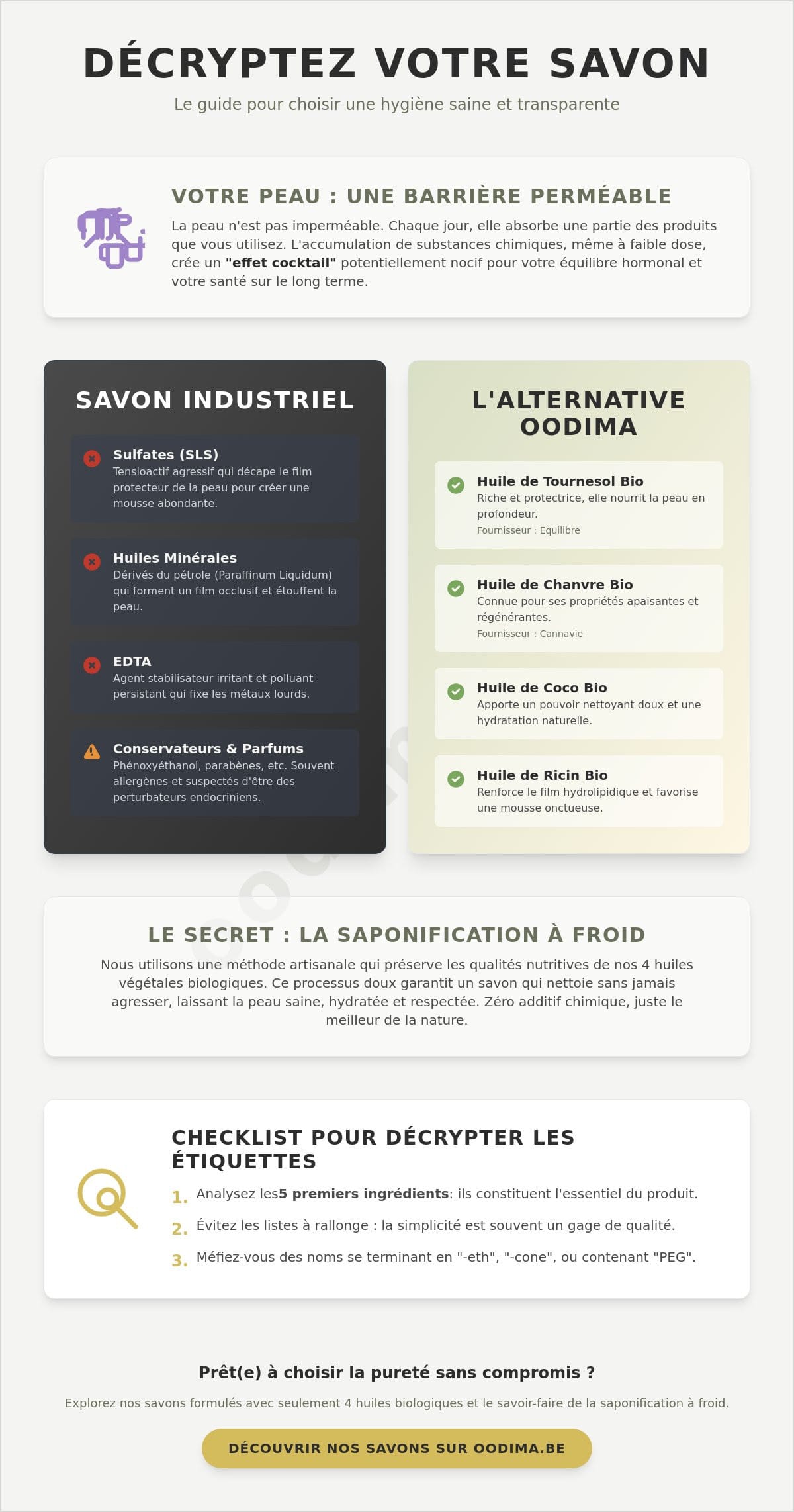
The skin is more than just an impermeable protective envelope. It’s our body’s largest organ, with a surprising capacity for absorption. Every time you use a hygiene product, the molecules it contains come into direct contact with your dermal system. This is where understanding the INCI nomenclature (International Nomenclature of Cosmetic Ingredients) becomes essential. If you consult an official Cosmetic Ingredient List, you’ll quickly realize that most mass-market products are packed with complex synthetic substances. The daily accumulation of these micro-doses creates what experts call the cocktail effect. Even if a substance is considered tolerable in small doses, its repeated interaction with dozens of other components in your routine can upset your hormonal balance. Identifying the ingredients to avoid in soaps is therefore not just a passing trend; it’s a genuine preventive measure for your overall health.
The skin: a permeable barrier to toxic substances
Our dermis is covered by a precious hydrolipidic film, a mixture of sebum and sweat that protects against external aggression and maintains hydration. Industrial soaps often use aggressive surfactants that violently strip away this natural barrier. Once this shield is destroyed, the skin becomes an open door to environmental toxins. Areas where the skin is thinnest, such as the face or mucous membranes, absorb these compounds much more quickly than the hands or feet. As well as causing immediate irritation, these products alter the skin’s microbiome, the colony of micro-organisms essential to our immunity. A quality organic soap must cleanse without ever compromising this delicate biological harmony.
The importance of transparency in daily hygiene
Modern marketing has mastered the art of greenwashing. A label displaying images of flowers or the word “natural” in no way guarantees the absence of endocrine disruptors or petrochemical derivatives. True transparency lies in a careful reading of the ingredients list. At Oodima, our approach is based on an ethic of responsibility. We have chosen to totally exclude controversial substances and focus on the raw quality of our raw materials. Our formulations are based exclusively on four organic vegetable oils: sunflower from Equilibre, hemp from Cannavie, coconut and castor. This rigorous selection enables us to offer a 100% natural liquid soap, far removed from the opaque formulations of conventional industry. Knowing which ingredients to avoid in soaps allows you to choose artisans who put your well-being first, rather than simply reducing production costs.
##The black list: ingredients to avoid in soaps
Drawing up a list of undesirable components is a necessary step in protecting your health. Regulations are evolving, but many problematic substances are still authorized within certain limits. If you consult the list of ingredients banned by the FDA or recent European regulations, you’ll understand that individual vigilance remains the best defence. Precise identification of the ingredients to be avoided in soaps can help you avoid the risks of allergies and hormonal disruption right from the outset.
Sulfates, such as Sodium Lauryl Sulfate (SLS), open this black list. These cheap surfactants are responsible for the abundant foam that many mistakenly associate with effectiveness. In reality, they strip away the protective lipids in the dermis. Then there’s EDTA, a chelating agent used to stabilize formulas. Not only is this component irritating, it is also a persistent pollutant that binds heavy metals. Mineral oils, often labelled Paraffinum Liquidum, are petroleum derivatives. They form an occlusive film that suffocates the skin rather than nourishing it. Finally, preservatives such as Phenoxyethanol and parabens are suspected of being major endocrine disruptors.
Faced with this complex chemistry, choosing an organic soap made with transparency becomes a priority for the whole family.
Aggressive surfactants and the myth of foam
Foam is not a guarantee of cleanliness. It’s a chemical reaction created to satisfy our sensory habits. Sodium Lauryl Sulfate is so aggressive that it is used in laboratories to irritate skin before testing soothing creams. For people with eczema or atopic skin, these sulfates aggravate inflammation over the long term. Even some chemically-processed coconut derivatives can prove irritating if not balanced with high-quality vegetable fats. At Oodima, we prefer the natural softness derived from the saponification of our four organic oils: Equilibre sunflower, Cannavie hemp, coconut and castor.
Preservatives and texture agents: invisible dangers
Industrial liquid soaps are particularly rich in preservatives, as their high water content encourages bacterial growth. To guarantee three years’ shelf stability, manufacturers add antibacterial agents such as Triclosan, suspected of promoting antibiotic resistance. EDTA, meanwhile, is used to prevent soap from going rancid or changing color. These molecules are not biodegradable and end up accumulating in aquatic ecosystems after each shower. Opting for a cold-saponified soap or a 100% natural liquid soap eliminates these unnecessary and environmentally harmful texturizing agents. It’s a healthier approach that respects your skin’s physiology without resorting to chemical tricks.
##Why does the cosmetics industry use these substances?
Understanding why manufacturers massively integrate ingredients to be avoided in soaps helps us to better perceive the stakes involved in our consumption. The short answer can be summed up in one word: profitability. For the major groups, producing millions of units requires raw materials that are ridiculously expensive and absolutely stable. Mineral oils, derived from petrochemicals, cost a fraction of organic vegetable oils. They never go rancid, and allow products to be stored for three years without any visible alteration. To maintain this artificial uniformity, the use of harmful chemicals in soaps becomes an unavoidable technical step in mass production.
Sensorial marketing also plays a major role. The industry has conditioned our expectations: we want abundant foam, a perfectly smooth texture and a fragrance that stays intense for months. Creating these characteristics naturally is complex and costly. Sulfates and synthetic texturizing agents offer an easy way to standardize the user experience, regardless of the actual quality of dermal care. This approach favors the illusion of efficacy over actual skin health.
The trade-off between profitability and skin health
Industrial saponification is generally carried out at high temperatures to speed up production. This brutal process often destroys the beneficial properties of the ingredients and requires the addition of additives to compensate for the loss of sweetness. Where a craftsman carefully selects each component, the factory uses fillers to cut costs. Labels are then filled with stabilizers and foam boosters that mask a poor washing base. It’s a system designed for large-scale national distribution, where the product has to withstand long transport and extreme temperature variations without ever going out of phase.
This quest for excellence and respect for raw products is a value shared by other local players, such as Conserverie Maison Marthe, which offers advice on using traditional techniques such as barbecued smoking to sublimate flavors.
The challenges of natural living cosmetics
Formulating an organic liquid soap without synthetic preservatives is a technical challenge that few major brands are willing to take up. A natural soap is a living product. Its color may change slightly depending on the plant harvest, and its scent, derived from essential oils or macerates, is more subtle. At Oodima, we embrace this authenticity. By working with local partners such as Equilibre for our sunflower oil and Cannavie for our hemp oil, we guarantee a freshness that the industry cannot offer. Our recipes, limited to four organic oils (sunflower, hemp, coconut and castor), prove that healthy hygiene doesn’t require a list of ingredients to be avoided in soaps, but simply a return to the rigor of craftsmanship.
##Checklist: How to decipher the label on your soap?
Analyzing the composition of a product shouldn’t take you more than 30 seconds. To protect your skin, all you need to do is adopt a structured approach. The INCI list arranges ingredients in descending order of weight: the elements present in greatest quantity appear at the top of the list. By isolating the first five ingredients, you identify around 80% of the formula. This is where the main ingredients to be avoided in soaps often hide, such as aggressive surfactants or inexpensive fillers.
If you spot names ending in -paraben, -eth (a sign of ethoxylated molecules), -one (often silicones) or -xynol, be on the lookout. These suffixes generally indicate synthetic substances or potential endocrine disruptors. Conversely, a quality product will feature Latin names designating pure vegetable oils. To ensure impeccable hygiene, you can now discover our range of Belgian and organic liquid soaps formulated without any of these suspect additives.
The first 5 ingredients: the heart of the formula
If the word Aqua comes first, you’re mostly paying for water. Although necessary in a liquid soap, it shouldn’t mask a lack of active ingredients. Learn to recognize good vegetable fats. In our formulations, you’ll systematically find four pillars: Potassium sunflowerseedate (saponified sunflower oil from Equilibre), Potassium hepseedate (saponified hemp oil from Cannavie), Potassium cocoate (saponified coconut oil) and Potassium castorate (saponified castor oil). These oils constitute the actual cleansing base. Also check the glycerine: it must be derived naturally from the saponification process and not added synthetically to compensate for a lack of mildness.
Tips for identifying allergens and colorants
Allergens often close the INCI list. They must be mentioned as soon as they exceed a certain threshold, even if they come from natural essential oils. Don’t confuse Fragrance or Parfum (often synthetic and opaque) with natural plant components such as Limonene or Linalool. For colors, the rule is simple: colorants are indicated by the prefix CI followed by five digits. An artisanal Belgian soap will prefer clays or plant extracts for its shades. By avoiding ingredients to be avoided in soaps and choosing rigorous organic labels, you can guarantee your skin’s barrier a respectful, long-lasting treatment.
##The Oodima commitment: Uncompromising purity
Oodima’s commitment is based on a simple conviction: your hygiene should never be at the expense of your health. By choosing to produce locally in Liège, we position ourselves as a protective guide for your skin. Our approach offers a radical alternative to the ingredients to be avoided in industrial soaps. We prefer cold saponification, an ancestral method that preserves all the glycerine naturally produced during the reaction. Unlike industrial hot processes that denature raw materials, this technique preserves the integrity of our four organic vegetable oils: sunflower, hemp, coconut and castor.
Our local roots in Wallonia are not just a marketing ploy. It’s a strong ethical choice that favors transparency and quality. We work with trusted partners such as Equilibre for our sunflower oil and Cannavie for our hemp oil. This total control of the supply chain guarantees exceptionally fresh, short-circuit soap. We offer a Belgian organic liquid soap that respects both your skin and the environment. It’s this rigor that defines our identity as a responsible manufacturer.
100% natural liquid soap: a handcrafted feat
Most shower gels sold in supermarkets are in fact synthetic detergents derived from petroleum. At Oodima, our 100% natural liquid soap is the fruit of genuine craftsmanship. We achieve a creamy texture and effective cleansing without any harsh preservatives or petrochemical texturing agents. This formulation scrupulously respects your skin’s hydrolipidic film, preventing tightness after showering. To better understand the fundamental distinction between an industrial product and a genuine skin care product, we invite you to consult our guide: Why choose a 100% natural liquid soap?
An ethic of total transparency
Transparency is at the heart of our identity as conscious experts. We reject the opacity of indecipherable INCI lists, which often conceal dubious ingredients. You won’t find any of the ingredients to avoid in the soaps we’ve detailed in this guide. No sulfates, no EDTA, no endocrine disruptors. Just the raw, protective power of nature. Our solid and liquid soaps are designed for those seeking vibrant, local, uncompromising care. We invite you to explore our creations and discover how healthy hygiene can transform your skin’s daily comfort.
##Towards more conscious and protective hygiene
You now have the essential keys to deciphering complex labels and identifying the ingredients to avoid in conventional soaps. Choosing healthy hygiene is not just a gesture for your immediate comfort; it’s a lasting commitment to the balance of your dermis and respect for our environment. By opting for transparency and simplicity, you can offer your skin a protective care product free from superfluous additives and controversial substances.
Our approach at Oodima is based on an ethic of absolute purity and responsibility. Our creations are the fruit of rigorous Belgian artisanal production, using cold saponification to preserve all the richness of our four organic oils: Equilibre sunflower, Cannavie hemp, coconut and castor. Each product is certified organic to guarantee total safety and perfect harmony with your body.
Ready to transform your bathroom into an authentic space of well-being? Discover our 100% natural liquid and solid soaps and rediscover the pleasure of a soothing shower. Your skin deserves this daily attention and renewed kindness.
##Frequently asked questions about soap composition
What are the most dangerous surfactants in soaps?
Sulfates, mainly Sodium Lauryl Sulfate (SLS) and Sodium Laureth Sulfate (SLES), are the most problematic for skin balance. These substances are designed to produce abundant foam, but end up stripping away the skin’s natural protective film. They are systematically at the top of the list of ingredients to be avoided in soaps for people suffering from chronic dryness or irritation.
Why is EDTA present in almost all industrial soaps?
EDTA acts as a chelating agent, stabilizing formulas and preventing soap from going rancid or changing color over time. It enables manufacturers to guarantee a visually perfect product for several years on the shelf. However, it is a persistent pollutant that does not degrade in nature and can bind heavy metals to your skin.
How do I know if my soap contains palm oil?
You can identify palm oil under the names Sodium Palmate or Elaeis Guineensis in the INCI list. Its intensive production is linked to major ecological issues. At Oodima, we have chosen to exclude it completely from our recipes. We favor the local quality of Equilibre’s sunflower and Cannavie’s hemp to ensure ethical and transparent production.
Does Marseille soap contain ingredients to avoid?
Genuine traditional Marseille soap is healthy, but industrial versions often hide undesirable additives. Many modern manufacturers add synthetic fragrances, artificial colorants or EDTA to cut costs. So it’s essential to check the label to make sure it doesn’t contain animal fats or petrochemical derivatives masked under a reassuring name.
What are the natural alternatives to synthetic preservatives?
Cold saponification naturally creates a high pH environment that limits bacterial development without external help. Tocopherol (vitamin E) and Rosemary extract, in particular, are alternatives that guarantee product freshness while respecting your skin’s physiology, unlike formaldehyde releasers or parabens.
Can natural fragrances be irritating to the skin?
Yes, essential oils naturally contain molecules such as Limonene and Linalool, which can be allergenic to some people. It is estimated that between 1% and 3% of the European population is sensitive to these components. That’s why they are compulsorily mentioned at the end of the INCI list, enabling even the most reactive skins to make an informed choice.
Why doesn’t my organic soap lather as much as a conventional shower gel?
The abundant foam of conventional products is the result of irritating chemical boosters, not a guarantee of effective cleansing. Organic soap relies on the natural properties of vegetable fats. In our formulations, the creaminess comes from the balance between coconut oil and castor oil. The result is a fine, creamy lather that cleanses perfectly without damaging the skin barrier.
How to recognize an endocrine disruptor on an INCI label?
Look out for names ending in -paraben or substances such as Triclosan and Phthalates. These molecules are suspected of interfering with your hormonal system and are ingredients to be avoided in soaps for healthy hygiene. By choosing certified organic Belgian handcrafted products, you can be sure of using care products formulated according to safety criteria that are far more stringent than standard regulations.