Did you know that a 2023 dermatological study found that 15% of users experience skin irritation from products containing 10% SLS? That tight, tight feeling on your skin after a shower isn’t inevitable—it’s often the result of invisible chemical damage. At Oodima, we understand your frustration with indecipherable INCI lists and that feeling of being misled by greenwashing. It’s essential to understand that sodium lauryl sulfate (SLS) is harmful to the skin, as this industrial surfactant weakens your skin barrier by stripping away its natural protective oils.
We promise to give you the tools you need to understand your cosmetics and protect your health in the long term. This article will teach you how to identify sulfates on a label and find an alternative that cleanses without irritating your skin. Together, we’ll explore the technical difference between a synthetic detergent and a true cold-processed liquid soap, rich in natural glycerin and local plant oils. You’ll discover how our artisanal methods and organic certifications guarantee a moisturizing and soothing skincare product that’s gentle on your body and our environment.
Key points
- Learn how to decipher INCI lists to identify industrial detergents that are often hidden behind misleading marketing terms.
- Understand why sodium lauryl sulfate is harmful to the skin—it weakens your natural protective barrier and causes tightness after showering.
- Take a look behind the scenes of the industry and find out why sulfates are preferred because of their rock-bottom cost, even at the expense of the quality of your skincare products.
- Discover the benefits of cold-process soap making with potash, an artisanal process that preserves natural glycerin and local plant oils.
- Learn what to look for in a Cosmos Organic-certified liquid soap to choose a healthy, eco-friendly, and truly moisturizing alternative.
Table of contents
What is sodium lauryl sulfate (SLS), and why is it everywhere?
Cold-process soap making: the true alternative for healthy skin
What is sodium lauryl sulfate (SLS), and why is it everywhere?
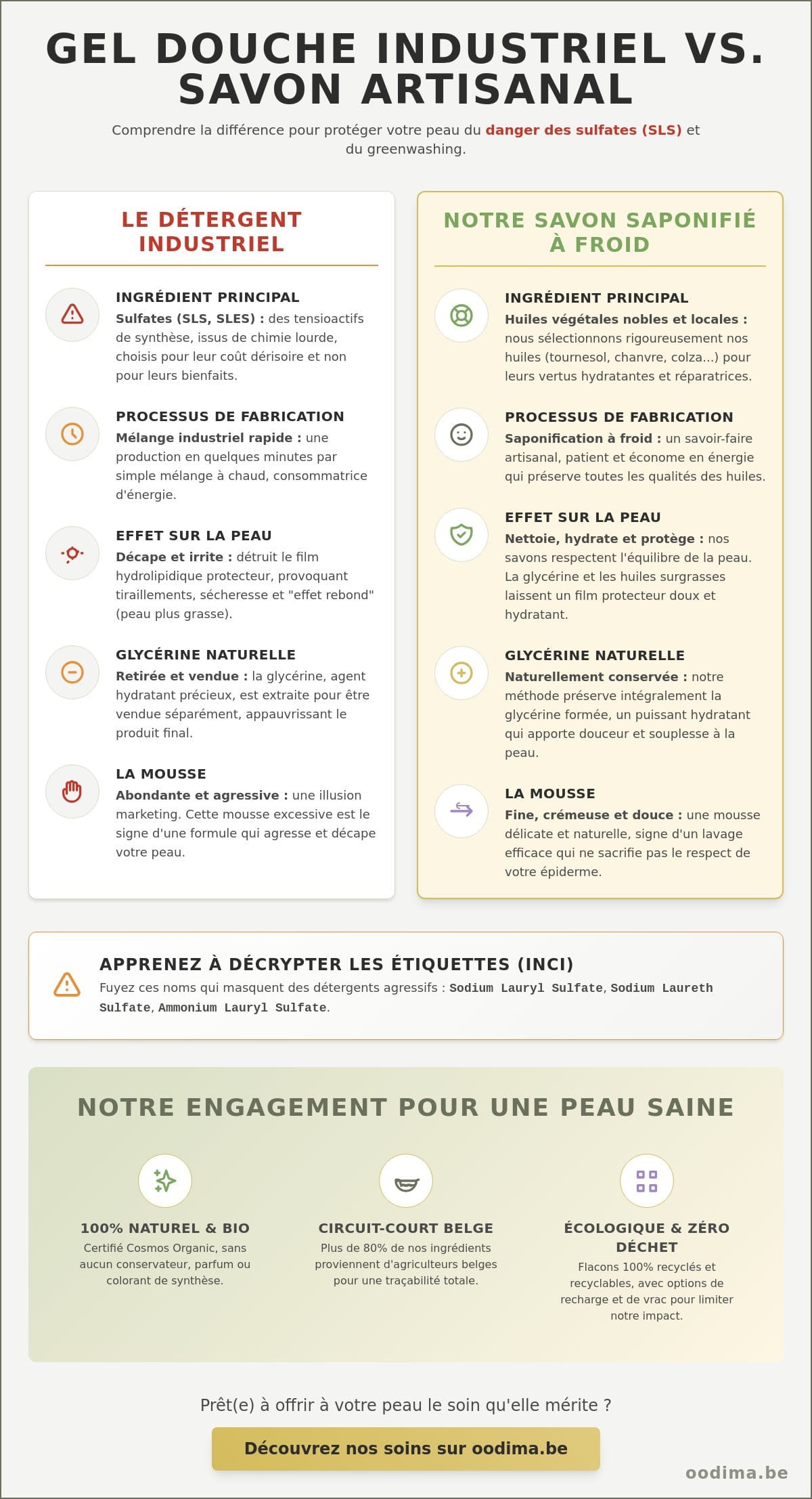
To fully understand why sodium lauryl sulfate is harmful to the skin, you first need to look at its technical data sheet. What exactly is sodium lauryl sulfate (SLS)? It is an ionic surfactant—a molecule designed to separate the skin’s natural oils and suspend them in water. The cosmetics industry uses it extensively for one simple reason: its production cost is negligible. Unlike the high-quality plant oils we source locally, SLS is the result of a heavy chemical processing. Although it’s often derived from palm or coconut oil, the final product is no longer natural in any way. It is found in about 90% of conventional cleansing products because it allows for the production of industrial quantities in just a few minutes through a simple hot-mixing process. This is the antithesis of our artisanal and patient approach in our laboratory in Seraing.
The Difference Between SLS, SLES, and ALS
Sodium Laureth Sulfate (SLES) is often marketed as a gentler alternative. It is actually SLS that has undergone ethoxylation, a polluting chemical process that reduces immediate irritation but remains problematic for the environment. As for Ammonium Lauryl Sulfate (ALS), it frequently appears in products that claim to be “natural” or “organic” but are not certified. Despite their various names, these molecules share an aggressive structure. They pose a risk to the skin because they are synthetic detergents, similar to those used in industrial cleaning. In 2026, with 63% of consumers actively seeking natural ingredients according to the latest market data, it is crucial to understand that these sulfates remain the industry’s default choice solely for reasons of profitability.
The Foam Illusion: A Marketing Trap
The industry has succeeded in embedding a misconception in the collective consciousness: the more it lathers, the cleaner it is. Yet this abundant lather generated by SLS is a sensory trap. It’s often used to mask formulas that are low in active ingredients, consisting mainly of water and synthetic polymers. In reality, excessive lather is a sign of a product that strips away the hydrolipidic film. At Oodima, we use cold-process saponification with potash for our liquid soap. This process naturally preserves the glycerin and the beneficial properties of our hemp, sunflower, coconut, and castor oils. The result is a fine, creamy lather and, above all, a product that respects your skin’s natural balance without ever stripping it.
The Real Dangers of SLS to Your Skin’s Balance
The skin is not merely an inert outer layer. It is a complex organ protected by an invisible yet vital barrier: the hydrolipid film. When sodium lauryl sulfate (SLS) is analyzed, what stands out most is a sudden disruption of this balance. This natural mixture of sebum and sweat seals the epidermis and protects it from bacterial attacks. SLS, by its very nature as a powerful ionic detergent, makes no distinction between impurities and your protective lipids. It dissolves them with the same aggressiveness as a degreaser used in mechanics, leaving your skin vulnerable and dehydrated. While industrial maintenance experts such as BioKem Oil Services use advanced methods to purify machine oils, these processes, by contrast, illustrate just how harsh such surfactants are on the skin barrier.
This repeated aggression often causes what dermatologists call the rebound effect. By stripping away sebum too aggressively, SLS sends a distress signal to your sebaceous glands. To compensate for the sudden dryness, these glands produce excess oil. This is how a commercial body wash can, paradoxically, make your skin oilier or contribute to the development of breakouts. For parents of babies or people with atopic skin, this mechanism is particularly harmful. S
The Breakdown of the Hydrolipidic Film
Skin lipids are the “cement” of your skin. They help retain water in the tissues and keep the epidermis supple. When sulfates come into contact with these essential fats, they instantly dislodge them. Without this protective barrier, water evaporates rapidly. The consequences are immediate: tightness, widespread redness, and, in the long term, premature aging. Unlike the industry, which often removes glycerin to resell it, our cold-process saponification method preserves this precious moisturizing molecule at the heart of every liquid soap.
Awareness and Contact Allergies
Chronic use of products containing SLS can turn healthy skin into reactive skin. The danger that sodium lauryl sulfate (SLS) poses to the skin also lies in its ability to increase skin permeability. By creating micro-breaches in the protective barrier, it facilitates the passage of other allergens or synthetic preservatives. It is no coincidence that toxicologists use SLS as a reference irritant to test the effectiveness of soothing creams. It is the gold standard for irritation. For pregnant women, whose skin is already subject to hormonal fluctuations, avoiding this chemical stress is a key step in preventing itching and contact dermatitis.
Why does the cosmetics industry continue to use sulfates?
If studies confirm that sodium lauryl sulfate (SLS) is harmful to the skin, why does it remain the star ingredient on supermarket shelves? The answer can be summed up in two words: profit and logistics. For large corporations, SLS is a financial windfall. Its production cost is virtually zero compared to the high-quality vegetable oils we use, such as hemp from Wallonia or sunflower oil from Liège. While we take the time for a slow saponification process, the industry favors an instant hot-mix method. All it takes is mixing water, sulfates, and salt to achieve a thick consistency in just a few minutes. This speed allows for the production of thousands of liters per hour—a pace incompatible with our artisanal values.
The chemical stability of SLS also makes it easier to manage long supply chains. An industrial body wash can be stored for months in warehouses without its texture changing. At Oodima, we take a different approach. Our “Fair Producer Price” commitment means we prefer to pay local farmers fairly rather than invest in cheap synthetic surfactants. Every batch that leaves our laboratory in Seraing is the result of gentle and transparent chemistry, far removed from the demands of extreme profitability that disregard consumer health.
Profit vs. Health: The Choice Facing Major Corporations
An analysis of the profit margins on conventional shower gels is eye-opening. These products are more than 80% water and sulfates. Even more concerning is that the industry systematically removes the natural glycerin produced during manufacturing to resell it separately to the pharmaceutical industry. In our liquid soap, this glycerin is retained in its entirety. It provides the moisturizing and restorative benefits that detergents cannot offer. For manufacturers, cold saponification is considered unprofitable because it requires too much time and high-quality raw materials.
The Hidden Environmental Impact of Sulfates
Sodium lauryl sulfate (SLS) is associated with an environmental disaster that is often overlooked. Once rinsed off, these surfactants end up in wastewater. They are toxic to aquatic organisms, disrupting river ecosystems. Their petrochemical production also has a heavy carbon footprint. By winning the Circular Economy Award in 2023, we proved that a short-supply-chain alternative is possible. Using more than 80% Belgian ingredients drastically reduces our environmental footprint while ensuring a product of absolute purity for your family.
How to Spot Sulfates and Make Sense of Your INCI List
Given how confusing product labels can be, becoming an informed consumer is your only real protection. To avoid Sodium Lauryl Sulfate (SLS), you need to learn to read between the lines of cosmetic jargon. The INCI list, which is required on every bottle, lists ingredients in descending order by weight. If you see any of the following terms in the top three positions, your product is essentially a diluted detergent:
Sodium Lauryl Sulfate (SLS): the harshest and most irritating.
Sodium Laureth Sulfate (SLES): less irritating but produced through a polluting process.
Ammonium Lauryl Sulfate (ALS): often used to disguise the presence of sulfates under a less familiar name.
Be wary of marketing claims such as “coconut-based.” This is a common greenwashing ploy. Although SLS may be derived from lauric acid in coconuts, the heavy chemical processing it undergoes negates all the plant’s benefits. A truly natural liquid soap does not contain these complex names. It simply lists saponified oils, such as Potassium Sunflowerseedate or Potassium Hempsedate, which indicate a gentle and respectful formulation.
Tips for Reading a Cosmetics Label
The rule is simple: if a sulfate is listed second on the ingredient list, right after water, steer clear. This product will damage your skin barrier every time you wash. A cold-processed artisanal soap will never need these synthetic foaming agents. Also learn to spot preservatives such as sodium benzoate, potassium sorbate, methylisothiazolinone, or parabens, which are often combined with sulfates to stabilize these delicate formulas. With us, the purity of our Belgian oils and the cold-process manufacturing method guarantee natural preservation and optimal skin tolerance—no preservatives needed.
Legal Guarantees and Transparency
Beyond mere promises, the law strictly regulates the marketing of cosmetics. Every product we create in our Seraing laboratory must have a Product Information File (PIF). This technical document is validated by an independent toxicologist who certifies the safety of the formula. We then register each product on the European CPNP portal. Stéphane and Sylvie emphasize this rigor because it protects you from illegal products or small-scale manufacturers who ignore these crucial steps, which are required by law and European regulations.
Our commitment to complete transparency earned us the Circular Economy Award in 2023. We believe that explaining what we do is the best way to combat the widespread practice of greenwashing. If you’d like to learn more about our manufacturing methods or our locally sourced ingredients, please feel free to ask us your questions directly. We’d be happy to guide you toward a healthier and more ethical skincare routine.
Cold-process soap making: the true alternative for healthy skin
To provide a sustainable alternative to Sodium Lauryl Sulfate (SLS), we’ve chosen to return to a gentle, time-honored method: cold saponification with potash. Unlike the industry’s instant mixes, this artisanal process carried out in our laboratory in Seraing preserves the integrity of our raw materials. From weighing the ingredients to bottling, our manufacturing process takes a minimum of 10 days. Each step is crucial and time-consuming; in particular, the black soap—which is the first step after saponification—must be allowed to rest to develop its full potential. This manufacturing method naturally preserves glycerin, a valuable humectant that is often extracted from industrial soaps for resale. In our formulas, it remains intact to ensure a moisturizing and restorative cleansing experience, leaving a protective film on your skin without irritating it.
Our commitment to supporting local producers drives us to use more than 80% Belgian ingredients. We select sunflower oil from Liège and hemp from Walloon Brabant, complemented by the benefits of coconut and castor oil. This blend creates a naturally moisturizing liquid soap, ideal for the whole family. To ensure complete safety, we offer our products in several versions tailored to specific needs:
Unscented version: Formulated without essential oils, it is soothing and safe for babies, pregnant women, and people with atopic skin.
Lavender: A floral and relaxing aroma, perfect for a moment of total relaxation in the shower.
Geranium and Ylang-Ylang: A balanced and enchanting blend that offers a gentle and harmonizing sensory experience.
Lemon and Peppermint: A fresh, invigorating scent that provides an immediate energy boost in the morning.
Cloves, Cinnamon, and Orange: A warm, spicy profile reminiscent of the comforting scents of winter—an aromatic richness that is also found in the Spice Rebels selections.
Oodima: A Commitment to Your Health and the Planet
Our mission to offer a “true alternative” to industrial shower gels goes beyond the formula itself. We’re fighting plastic waste by offering our products in 100% recycled and recyclable amber bottles, while promoting bulk purchases and refills. Winners of the 2023 Circular Economy Award, Stéphane and Sylvie guarantee that every step—from validation by a toxicologist to registration on the CPNP portal—is carried out with complete transparency. Discover our range of Cosmos Organic-certified liquid soaps today, designed with respect for the producer, the planet, and your health.
Adopt a gentle and protective skincare routine
Taking back control of your daily skincare routine is now within your reach. You now have the tools to identify Sodium Lauryl Sulfate (SLS) and understand why this industrial detergent has no place in your bathroom. By choosing cold-process soap-making and learning to decipher INCI lists, you’re opting for skincare that respects your skin’s natural balance without compromise. This transition to healthier cosmetics is an essential step for your health and for the environment.
At our laboratory in Seraing, near Liège, we passionately uphold this artisanal vision. Every bottle we produce is Cosmos Organic certified and reflects our commitment. We believe that an exceptional product is born from the combination of high-quality Belgian plant oils and ethical craftsmanship. Your skin deserves the gentleness of a true liquid soap, rich in natural glycerin and protective active ingredients.
If you have any questions about our products or your skin’s specific needs, we’re here to help. Protect your skin with our 100% natural liquid soaps and rediscover the pleasure of a soothing shower. Your well-being starts with informed choices.
Frequently Asked Questions About Sulfates and Natural Soap
Is Sodium Lauryl Sulfate (SLS) a carcinogen?
Sodium Lauryl Sulfate is not classified as a carcinogen by international or European health authorities. Its main risk lies in its strong irritating properties and its ability to structurally alter the skin barrier. Although it is not linked to cancer, chronic use of this ingredient promotes the penetration of other potentially harmful substances into the body by creating micro-breaches in the epidermis.
What is the difference between Oodima liquid soap and a store-bought sulfate-free body wash?
The main difference lies in the manufacturing process and the very nature of the product. An industrial sulfate-free shower gel often uses synthetic surfactants derived from petrochemicals, whereas our product is a true soap made through cold saponification with potash. This artisanal process preserves the beneficial properties of hemp, sunflower, coconut, and castor oils while retaining their natural, protective glycerin.
Why doesn’t my natural soap lather as much as a commercial product?
Abundant lather is a marketing gimmick created by harsh surfactants to mask formulas that are low in actual active ingredients. Our natural soaps produce a finer, creamier lather because we avoid synthetic foaming agents. Our formula contains coconut oil, which naturally produces lather. This delicate texture reflects the richness of the plant-based oils and ensures a cleansing experience that respects your skin’s natural balance without ever stripping it.
Are sulfates dangerous for babies and pregnant women?
Sulfates are not recommended for babies and pregnant women because their skin barrier is more fragile. This is especially true since their skin is more permeable to chemical irritants. Our fragrance-free formulas are specifically designed to safely protect these vulnerable skin types, drawing on the gentleness of our locally sourced oils.
How can I tell if my skin has a bad reaction to sodium lauryl sulfate?
The most common signs of a reaction to sodium lauryl sulfate (SLS) are tightness, redness, or itching after showering. If your skin feels uncomfortable or “too clean”—to the point where it looks shiny but lacks suppleness—it means your hydrolipidic film has been compromised. This repeated skin stress can lead to chronic sensitization and the appearance of dry patches.
Is Sodium Laureth Sulfate (SLES) really gentler than Sodium Lauryl Sulfate (SLS)?
Sodium Laureth Sulfate (SLES) is indeed less irritating than SLS thanks to ethoxylation, but this chemical process is extremely harmful to the environment. So we end up with SLS, which is harsher (but accepted in organic products if the minimum organic ingredient threshold is met), and SLES, which is gentler (but banned in organic products because its manufacturing process is disastrous in terms of pollution). Furthermore, it may contain traces of undesirable residues such as 1,4-dioxane. At Oodima, gentleness must never come at the expense of environmental sustainability or product purity, which is why we exclude both of these compounds.
Can cold-process soap be used for intimate hygiene?
Yes, our cold-processed soaps without essential oils are ideal for external intimate hygiene thanks to their 100% natural formula. Their high glycerin content and absence of synthetic preservatives respect the sensitivity of this delicate area. They gently cleanse without disrupting the delicate balance of the local flora, offering a healthy alternative to commercial shower gels, which are often too harsh.
Why is natural glycerin so important in soap?
Natural glycerin is an exceptional humectant that attracts and retains water in the upper layers of the skin. Unlike industrial detergents, which systematically remove it to resell it, we retain all of it within our soap. It is this very presence that transforms washing into a truly moisturizing and restorative treatment, essential for maintaining the suppleness and health of your skin.